
Vape Batteries Explained: Safety, Cold Weather and Recycling
Every vape, from a refillable box mod to a sealed disposable, runs on a lithium-ion battery. It’s the one part of the hardware that stores energy and can release it on its own if something goes wrong. The good news: most battery incidents trace back to a handful of avoidable habits. Here’s how these cells work, what’s inside a disposable, how heat and cold affect them, how to choose and look after them, and how to recycle them properly when they’re done.
If a battery is hissing, smoking or getting hot right now, skip to what to do.
The chemistry, in plain terms
A lithium-ion cell moves lithium ions between two electrodes through a liquid or gel electrolyte. Charging pushes the ions into the graphite (negative) electrode. When you vape, the ions flow back to the metal-oxide (positive) electrode inside the cell, while a matching stream of electrons takes the outside route through your device. That electron flow is the current that heats the coil. A thin plastic separator keeps the two electrodes from touching.
That electrolyte is flammable, which is why a failing cell can burn instead of just dying. If the cell gets hot enough – from a short circuit, a crush, overcharging or outside heat – the separator breaks down, the electrodes touch, and the cell heats itself faster than it can shed the heat. This is thermal runaway. The cell vents hot gas, can catch fire, and in a tube-shaped device can push the cell out with real force.
Cells are sold under different cathode chemistries. You’ll mostly see the first three in vaping:
| Chemistry | Often labelled | Nominal / full charge | Thermal runaway starts around | Where you’ll find it |
|---|---|---|---|---|
| Lithium manganese oxide (LMO) | IMR | 3.7V / 4.2V | 250°C | Older high-drain 18650s |
| Nickel manganese cobalt (NMC) | INR | 3.6-3.7V / 4.2V | 210°C | Most current 18650 and 21700 vape cells |
| Lithium cobalt oxide (LCO) | ICR, or no code on pouch cells | 3.6V / 4.2V | 150°C | Phones, and many of the small built-in cells in pod systems and disposables |
| Lithium iron phosphate (LFP) | IFR | 3.2-3.3V / 3.65V | 270°C | Rare in vaping – too low-voltage for most mods |
Figures from Battery University. A higher number means more heat is needed before runaway begins. LCO sits lowest on that list yet it’s common in sealed devices; those cells are small, sealed in and never handled, which is why sealed devices rarely cause trouble. The removable cells in mods are where your own choices matter most.
Cell formats. The name is the size: an 18650 is 18mm wide and 65mm long, a 21700 is 21 x 70mm, and a 20700 sits between them. These are the most common removable cells in box mods. Pod systems and disposables use built-in cells, either small cylindrical cells or flat pouch cells, which you never handle directly.
What’s inside a disposable
Every disposable has a real lithium-ion battery inside – the same basic technology as your phone. On the disposables we carry, the built-in battery ranges from about 200mAh (the small cell inside a Gcore Sync pod) to 1,700mAh (the non-rechargeable Gcore Prime 15000). mAh is milliamp-hours, a measure of how much charge a cell holds. Most current models sit at 700-1,000mAh and recharge over USB-C.
Those cells are better than their name suggests. A 2023 study in the journal Joule found that cells from single-use vapes could be charged and discharged more than 450 times, and kept over 90% of their capacity past 700 cycles at gentle rates.
Two things follow from that:
- “Empty” doesn’t mean discharged. A disposable is usually thrown out while its battery still holds plenty of charge. Researchers who took apart used disposables found every battery still held enough charge to light a bulb for at least an hour.
- That leftover charge is a fire risk in garbage trucks and sorting plants. A compactor can crush a charged cell into a short circuit. That’s why disposables go to a household hazardous waste or e-waste depot, never the trash or the blue bin (see recycling below).
If your disposable has a USB-C port, treat it like any rechargeable device. Use an undamaged cable and a certified charger, charge it on a hard, flat surface where you can see it (not on a bed or couch, and not overnight), and unplug it when it’s full.
Injuries and burns: the Canadian record
Vape battery injuries are rare, and the Canadian burn cases that have been written up in detail share one pattern: a loose cell in a pocket with coins or keys.
What the cases look like. In February 2017, a Calgary man was left with third-degree burns to his leg and hand when a spare battery shorted against change in his pocket. Toronto’s Ross Tilley Burn Centre published two similar cases in 2017: both men carried cells loose with coins or keys, and both needed skin grafts. In the literature that team reviewed, nearly half of these burns needed surgery.
How often it happens. Canada has no national count of vape battery injuries, but two federal sources give a picture:
- Health Canada’s consumer product incident database logged 71 vaping-related reports from 2015 to September 2019. Explosion was the main hazard in 17, and burns made up 16 of the 39 injuries. Reports rose each year, from 4 in 2015 to 28 in the first nine months of 2019.
- A federal network of hospital emergency departments, weighted toward children’s hospitals, recorded 32 vaping-related injuries from 2013 to 2018. 78% were poisonings from swallowing e-liquid, nearly all in children aged four or under. 9%, about three cases, were burns from devices catching fire.
For scale, US emergency departments saw an estimated 2,035 vape explosion and burn injuries in 2015-2017. A US Fire Administration review of 195 incidents from 2009 to 2016 found the largest groups happened in a pocket (61) or during use (60), then while charging (48).
The Canadian and US figures come from different systems, so they can’t be compared directly. What the record does show is the same causes on both sides of the border.
What Canada does differently.
- Since the Tobacco and Vaping Products Act took effect in May 2018, nicotine vaping products have been a legal, regulated adult market. Before that, no nicotine vaping product was authorized for sale, and the market ran without clear rules.
- Vaping devices fall under the Canada Consumer Product Safety Act. Manufacturers, importers and sellers must report a safety incident to Health Canada within two days of learning about it, and Health Canada can order recalls.
- The vape-specific electrical safety standard, ANSI/CAN/UL 8139, is voluntary. Health Canada recommends choosing devices certified to it.
- As of August 2026, Health Canada is weighing mandatory safety requirements for lithium-ion batteries in consumer products.
The takeaway: buying from a legitimate Canadian retailer gets you products that sit inside that system. But regulation can’t stop a loose cell from meeting a set of keys. The habits in the rest of this guide do that.
If a battery fails: what to do
A failing cell usually gives warning: hissing or popping, a sweet or chemical smell, smoke, or getting hot fast. Calgary Fire Department’s advice is to move quickly, because a cell can go from those signs to flames in under a minute.
- Get it off your body. If it’s in a pocket, shake it out or take the garment off. Otherwise don’t handle it.
- Leave the area and call 911. Don’t breathe the smoke; it’s toxic. Don’t stay to fight the fire.
- It can flare up again. A cell that has vented or burned can reignite hours later. Once it’s safe, it goes to household hazardous waste, never the garbage.
For a burn: run cool water over it for at least 10 minutes, take off rings or watches near the burn, don’t use ice, butter or creams, and cover it loosely with a clean cloth or plastic wrap. See a doctor for any burn bigger than the person’s palm, any burn that blisters or looks white or charred, any burn to the hands, feet, face, groin or a major joint, any burn on a child, and if you breathed the smoke and feel short of breath or your throat hurts.
Heat and cold
Lithium-ion cells are happiest at room temperature. They can be used from about -20°C to 60°C, but they should only be charged between 0°C and 45°C.
Heat speeds up the chemistry that wears a cell out, and at the extreme it can start thermal runaway. Heat plus a full charge is the worst combination. Battery University’s estimates for a cell stored for a year:
| Storage temperature | Capacity left at 40% charge | Capacity left at 100% charge |
|---|---|---|
| 0°C | 98% | 94% |
| 25°C | 96% | 80% |
| 40°C | 85% | 65% |
| 60°C | 75% | 60% (after just 3 months) |
Source: Battery University, BU-702.
In summer:
- Don’t leave your vape or spare cells in a parked car, on a dashboard or in direct sun.
- Don’t charge a device that’s hot from heavy use or from sitting in the sun. Let it cool first.
- A pouch-cell device that gets puffy after a hot day has been damaged. Retire it.
Cold is a bigger everyday issue for most of Canada. Below freezing, the cell can’t deliver current as easily, so its voltage sags. Your device may read low, hit weakly or shut off, even though the charge is still there. Warm it back up and the reading recovers. E-liquid also thickens in the cold, which can cause dry hits.
The real danger is charging a cold battery. Below 0°C, lithium can plate onto the anode as metal instead of soaking in. That damage is permanent, cuts capacity, and makes the cell less safe. Health Canada’s advice is plain: don’t charge below zero, and bring batteries to room temperature before using them.
In winter:
- Carry your device in an inside pocket, close to your body. Keep it away from keys and coins.
- Don’t leave it in the car overnight.
- After coming in from the cold, let it warm to room temperature before plugging it in.
Choosing batteries and chargers
If you use a pod system or a disposable, the battery is chosen for you – your job is to buy the device from a legitimate retailer and charge it properly. If you use a box mod with removable cells, here’s what to check.
- Buy genuine cells from a trusted seller. Fakes are common online. One “3000mAh” cell bought online turned out to be a smaller cell padded out with a spacer, holding just 530mAh.
- Go by the continuous discharge rating (CDR). CDR is the most current a cell can supply steadily, from full to empty, without overheating. “Pulse” or “max” ratings on the wrap are often much higher and much less useful. Independent bench testers, such as Battery Mooch, publish real ratings for most popular cells. On our battery pages, we list the independent continuous rating where one exists.
- Be skeptical of big numbers. Higher capacity and higher current trade off against each other. Mooch’s rule of thumb is that no 18650 holds more than about 3,600mAh, and no 18650 in the 3,100-3,600mAh range can safely deliver more than about 10A continuous. A wrap that claims both is overstating something.
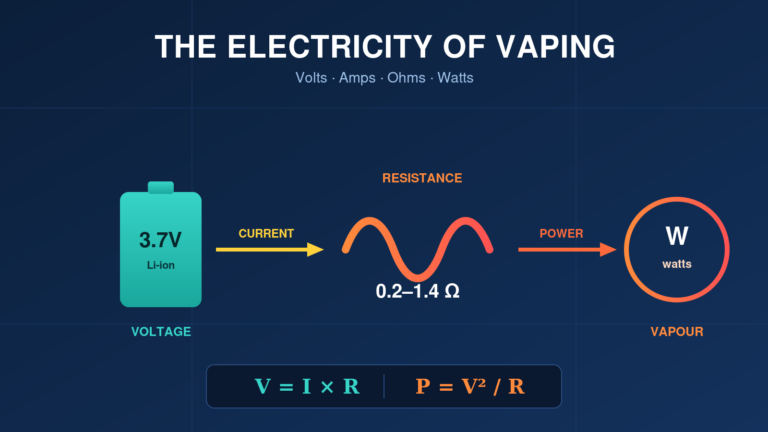
- Know what your mod draws. On a regulated mod, a higher wattage means more current from the cell, and the board pulls more current as the cell runs down to hold the same wattage from a lower voltage, so leave headroom under the CDR. On a mechanical mod there’s no board at all: the coil’s resistance and the cell’s voltage set the current, and a low build or a short pulls everything the cell can give. Our guide to volts, amps, ohms and watts walks through the math; if you can’t work it out, don’t use a mechanical mod.
- Use matched cells in multi-battery mods. Same brand, model and age, bought and charged together. Keep them as a set and don’t mix them with others.
- Keep the wrap and insulator ring intact. The metal can of a cell is the negative terminal, all the way up the side, and the small ring under the positive top cap is what keeps the positive contact from touching the can. A nick in the plastic wrap near the top can short it. A rewrap kit costs a few dollars.
- Use a proper external charger. A dedicated bay charger is usually gentler and easier to watch than charging through a mod. Health Canada says to use chargers with a recognized Canadian certification mark, such as CSA or cUL.
- Carry spares in a plastic case. Never loose in a pocket or bag. This one habit would have prevented the Canadian burn cases above, and pocket incidents were the largest group in the US review.
- Lock your mod before it goes in a pocket, so keys can’t hold the fire button down. On most mods that’s five quick clicks of the button.
- Look for certified devices. Health Canada recommends devices certified to ANSI/CAN/UL 8139, the North American electrical safety standard for vapes.
How long batteries last
A typical lithium-ion cell charged to 4.2V gives roughly 300-500 full charge-and-discharge cycles before it’s noticeably weaker. If you drain and recharge a mod cell once a day, plan on about a year. Lighter, partial cycles stretch that out, which is why the gently cycled disposable cells in the Joule study did better.
Batteries also age on the shelf, even unused. Heat and a full charge speed that up (see the table above).
What shortens battery life:
- Running the cell completely flat, again and again
- Leaving it sitting at 100%, especially somewhere warm
- Drawing near or past its CDR
- Charging when it’s below 0°C or hot
- Fast charging at high currents
What helps:
- Recharge before it’s empty. Lithium-ion has no “memory” (the old nickel-cadmium problem where partial charges shrank capacity), so topping up is fine.
- Unplug when it’s full.
- For storage longer than a few weeks, leave it at about half charge, somewhere cool and dry. Health Canada suggests checking stored batteries every 3 months and topping them back up to around 50%.
A cell that’s been left completely dead for a long time can be damaged. Battery University advises scrapping any cell that has sat below 2V for more than a week.
When to retire a battery
Retire a battery, or the device it’s built into, the moment you notice any of these:
- Swelling. A pouch-cell device that bulges, a case that won’t close, a cell that’s hard to remove. Stop using it and stop charging it.
- Damage to the wrap or can. Tears, nicks or a missing top insulator ring can be rewrapped. Dents, rust or crushed ends can’t.
- Heat. It gets hot during normal vaping or charging, when it used to stay warm at most.
- Smell or leaking. A sweet or chemical smell, or any wet residue, means the seal has failed. Hissing, smoke or a cell that suddenly gets hot is different: it’s venting right now. Follow the steps under if a battery fails.
- Poor performance. It now lasts half as long as it used to, or the voltage drops right after charging.
- Charger errors. Your charger flags it, won’t charge it, or it won’t reach full.
- Hard knocks or water. It’s been dropped hard, run over, or soaked.
- Left dead. It’s sat completely flat for more than a week.
A swollen or damaged battery doesn’t go in a regular drop-off box. Don’t puncture, squeeze or tape over a swollen cell, and don’t try to take it out of a device. Call2Recycle’s advice is to pack it in dry sand or kitty litter in a non-flammable container as soon as possible. Keep it out of the house if you can, away from anything that burns and out of reach of children, and take it to a household hazardous waste depot within days, not months. Some Call2Recycle sites have special containers for damaged lithium batteries; call ahead.
Recycling in Canada
Never put a vape, a disposable or a loose battery in the garbage or the blue bin. Health Canada treats batteries as hazardous waste. In a garbage truck or a sorting plant, a crushed cell can short and start a fire. Nova Scotia’s Valley Waste facility was badly damaged by a battery fire in July 2026, its ninth in three years. Calgary’s fire department lists vapes among the common sources of lithium-ion fires.
Where each item goes:
| Item | Where it goes |
|---|---|
| Disposables, pod devices and mods with built-in batteries | Your municipal e-waste or household hazardous waste depot |
| Loose 18650, 21700 and other cells | Any Call2Recycle drop-off (terminals taped), or your municipal depot |
| Swollen, leaking or damaged batteries | Household hazardous waste, packed in sand or kitty litter, never a regular drop-off box |
| Empty pods, tanks and coils with no battery | Check your local rules – they’re not batteries |
Your municipal depot (vapes and disposables). Many Canadian cities take vapes at their household hazardous waste or e-waste drop-off, usually free. Search your city’s “what goes where” tool for “vape”. A few examples:
- Edmonton: Eco Stations take rechargeable and disposable vapes with other electronics, free for residents. Bring the whole device – don’t try to remove the battery.
- Calgary: take e-cigarettes and vape pens to a City Eco Centre. The City asks that vapes never go in any of your carts.
- York Region, Ontario: rechargeable vapes count as household hazardous waste and go to a Regional waste depot.
Call2Recycle (loose batteries). Call2Recycle runs free battery drop-off at pharmacies, hardware stores, grocery stores and municipal depots across Canada. In Alberta it’s the province’s approved battery program as of April 2025. Find the nearest site with the locator at recycleyourbatteries.ca.
How to prep a battery for drop-off:
- Tape over both ends of loose cells with clear tape, or put each one in its own plastic bag.
- Store them in a plastic or glass container, not metal, somewhere cool and dry, out of reach of children and pets.
- Drop them off at least every three months.
- Don’t take devices apart to get the battery out.
Quick checklist
- Spare cells go in a plastic case, never loose with keys or coins. Lock your mod before it goes in a pocket.
- Charge at room temperature, somewhere you can see it, and unplug when full.
- Never charge a battery that’s below freezing or hot to the touch.
- Use certified chargers and genuine cells from a trusted retailer.
- Check wraps and insulator rings every time you swap cells.
- Retire anything swollen, dented, leaking or running hot.
- Keep devices, spare cells and e-liquid out of reach of children and pets. If a child swallows e-liquid or a battery, call your poison centre or 911.
- Recycle it. Never bin it.
Shopping for cells or a charger? You’ll find them in our Vape Chargers & Batteries collection. Not sure which suits your mod? Just ask us.
This guide is general safety information for adult vapers in Canada. It isn’t medical advice. In an emergency, call 911.
Vape battery FAQ
Can a disposable vape explode?
Any lithium-ion battery can fail, but failures of sealed devices from a legitimate retailer are rare. The Canadian burn cases on record mostly involve loose removable cells shorting against keys or coins in a pocket.
Is it safe to use my vape in the cold?
Yes, within reason. Most cells are rated for use down to about -20°C. Expect weaker performance below freezing, keep the device in an inside pocket, and don’t charge it until it has warmed to room temperature.
Can I leave my vape in the car?
Avoid it in both summer and winter. Summer heat speeds up wear and raises fire risk, and winter cold means you can’t safely charge it until it warms up.
Can I charge my vape with my phone’s fast charger?
Usually, yes, if it’s a certified charger in good condition. A USB device only draws the power it asks for, so a fast charger supplies a vape at ordinary USB power. The real risks are uncertified or damaged chargers and cables, and charging where you can’t see it. If the maker specifies a charger, use that.
How do I know my battery is fake?
You often can’t by looking. Buy from a trusted retailer, and be wary of capacity and amp ratings that seem too good. A genuine 18650 tops out at around 3,600mAh.
Can I fly with my vape?
Transport Canada requires vapes and spare batteries to go in your carry-on, never checked bags. Spares must be individually protected from short circuits, and you can’t use or charge a vape on board.
Where do I recycle a disposable?
At your city’s household hazardous waste or e-waste depot. Many take vapes for free. Never in the garbage or blue bin.
What should I do if my battery is swollen?
Stop using and charging it right away. Don’t puncture or squeeze it. Pack it in sand or kitty litter in a non-flammable container, keep it away from anything that burns, and take it to a household hazardous waste depot as soon as you can, not a regular battery drop-off box.